How to Respond to a Trademark Office Action
Share:

Michael N. Cohen
How to Respond to a Trademark Office Action
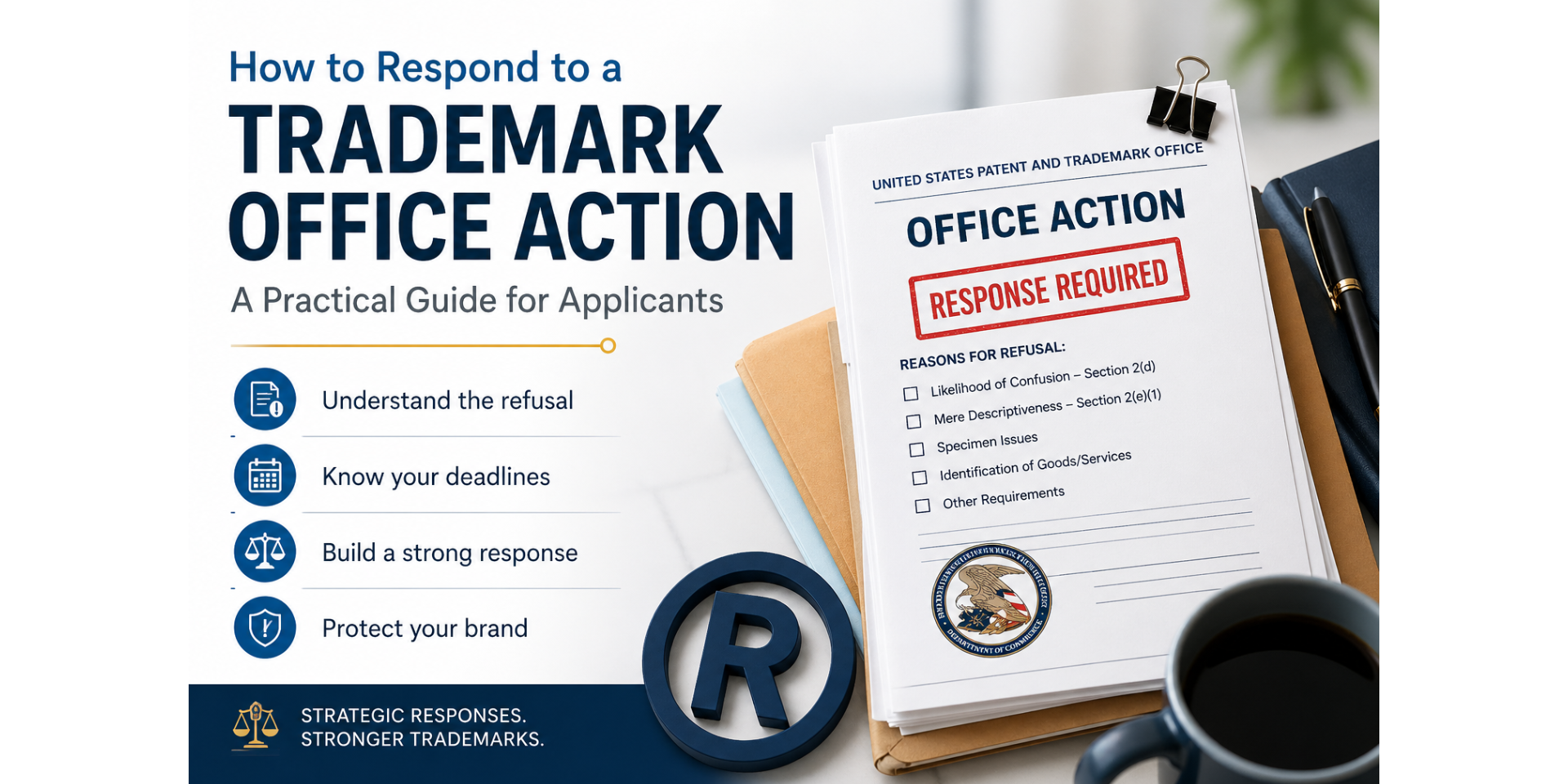
Receiving a Trademark Office Action from the United States Patent and Trademark Office (USPTO) can feel like your application has hit a wall. In most cases, it has not. An Office Action is the Examining Attorney’s formal communication identifying issues with your application, and a well-crafted response often resolves them. The key is understanding what the refusal actually says, what evidence or argument is required to overcome it, and how the deadline structure works.
This guide explains how Office Actions work, the categories of refusals applicants most often face, and what an effective response looks like. For a deeper overview of how our firm handles these matters end-to-end, see our Trademark Office Action services page.
What Is a Trademark Office Action?
An Office Action is a written letter from a USPTO Examining Attorney explaining why your trademark application cannot be approved as filed. It may identify substantive grounds for refusal, procedural defects, or both. Until each issue raised is resolved, the application will not move forward to publication or registration.
Office Actions generally fall into two categories:
- Non-Final Office Action. The first substantive refusal or set of issues. You have a full opportunity to respond, submit evidence, and present argument.
- Final Office Action. Issued when the Examining Attorney has reviewed your earlier response and remains unpersuaded. Your remaining options narrow to a Request for Reconsideration, an appeal to the Trademark Trial and Appeal Board (TTAB), or abandonment.
Response Deadlines: The 3-Month Rule
For applications filed on or after December 3, 2022, applicants generally have three months from the issue date to respond to an Office Action. A single three-month extension is available for a USPTO fee, but it must be requested before the original deadline expires. Applications filed under the Madrid Protocol (Section 66(a)) retain a six-month response window.
Missing the deadline results in abandonment of the application. Reviving an abandoned application is possible in narrow circumstances, but it is far easier — and far less expensive — to calendar the deadline correctly and respond on time.
Common Refusals and What They Require
Most Office Actions involve one or more of the following issues. Each requires a different response strategy.
Likelihood of Confusion — Section 2(d)
The Examining Attorney has identified a prior registered or pending mark believed to be confusingly similar to yours. Overcoming a 2(d) refusal typically requires legal argument under the DuPont factors, addressing the similarity of the marks, the relatedness of the goods or services, channels of trade, sophistication of consumers, and the strength of the cited mark. Consent agreements, coexistence arguments, and amendments to the identification of goods can also be effective tools.
Mere Descriptiveness — Section 2(e)(1)
The mark is refused because it merely describes a feature, function, quality, or characteristic of the goods or services. Responses generally argue that the mark is suggestive rather than descriptive, or alternatively, claim acquired distinctiveness under Section 2(f) with evidence of long-term use, advertising, and consumer recognition. Amending the application to the Supplemental Register is another option in appropriate cases.
Specimen Refusals
The specimen submitted does not show the mark used in commerce in the manner required for the goods or services claimed. This is one of the most common refusals for Amazon sellers and direct-to-consumer brands, particularly where the specimen is a mockup, a digital rendering, or a webpage that does not show a clear point of sale. A substitute specimen, supported by a verified declaration, is often the cleanest fix.
Identification of Goods or Services
The Examining Attorney requires more specificity, a corrected classification, or removal of an item that exceeds the scope of the original filing. These are usually the most straightforward issues to resolve, but careless amendments can permanently narrow your rights. Edits should be made deliberately.
Disclaimers, Translations, and Other Procedural Requirements
The USPTO frequently requires applicants to disclaim descriptive or generic wording, translate non-English elements, identify any persons named in the mark, or provide additional information about the goods. These requests are administrative in nature but must be addressed precisely and completely.
Building an Effective Response
A strong Office Action response generally includes three elements: a careful reading of every issue raised, legal argument supported by case law and TMEP authority where applicable, and evidence tailored to the specific refusal. Boilerplate responses rarely succeed, particularly for Section 2(d) and 2(e) refusals where the analysis is fact-intensive.
Several strategic considerations are worth weighing before filing a response:
- Preserve your priority date. Amendments, divisions, or new filings can affect priority and should be evaluated carefully.
- Avoid unnecessary admissions. Concessions made in a response can resurface later in opposition or cancellation proceedings, or in infringement disputes.
- Consider the long view. A registration that issues on a weakened or narrowed identification may not protect what your business actually does.
When to Involve Trademark Counsel
Procedural Office Actions — minor identification edits, disclaimers, or specimen substitutions — can often be handled directly by the applicant. Substantive refusals are different. A 2(d) likelihood-of-confusion refusal, a 2(e)(1) descriptiveness refusal, or a Final Office Action will typically benefit from experienced trademark counsel who can frame argument, marshal evidence, and protect the long-term value of the brand.
If you are evaluating your overall trademark strategy or considering broader brand protection, our trademark practice overview outlines the full scope of services we provide, from clearance and filing through enforcement and litigation.
Final Thought
An Office Action is not a denial. It is a roadmap for what the USPTO needs to see before your mark can register. Read it closely, calendar the deadline immediately, and respond with substance rather than form. The quality of the response often determines whether the application registers, registers in narrowed form, or is lost entirely.
Facing a USPTO Office Action?
Our firm represents founders, established companies, and Amazon sellers in responding to Office Actions of every type — from straightforward procedural requirements to complex Section 2(d) and 2(e) refusals. We focus on protecting both the application in front of you and the long-term enforceability of your brand.
Learn more about our Trademark Office Action services or contact our office to discuss your matter directly.